Category: occultism
-

YOGAPUNX discussion of Konx Om Pax
Okay, here is a detailed briefing document summarizing the main themes and important ideas from the provided excerpts of Aleister Crowley’s “Konx Om Pax”: The text is available in the library.
Briefing Document: Aleister Crowley’s Konx Om Pax
Overview:
Konx Om Pax is a collection of essays and stories by Aleister Crowley that explores themes of truth, illusion, morality, and spiritual awakening through a unique and often provocative lens. Crowley utilizes diverse forms including allegorical tales, philosophical dialogues, and poetic expressions. The work is characterized by a rejection of conventional morality and dogma, emphasizing individual experience and the transcendence of dualities. The text is filled with esoteric symbolism and references, including Qabalah, Tarot, and Eastern religions, which serve to illustrate Crowley’s unique worldview. The overall tone is challenging, irreverent, and often satirical, aiming to provoke the reader into a deeper understanding of themselves and the universe.
Main Themes & Key Ideas:
- The Transcendence of Opposites (Konx):
- Central to Crowley’s philosophy is the concept of “Konx,” which represents a state beyond the duality of opposites (A or not-A, good or evil, true or false). He states: “A thing is not necessarily A or not-A. It may be outside the universe of discourse wherein A and not-A exist.”
- This idea is directly tied to the LVX of the Rosicrucians, suggesting an illumination that transcends the limitations of conventional thinking.
- He uses the analogy of spherical trigonometry for those who don’t understand: “But to those who do not, it must (I fear) remain as obscure and ridiculous as spherical trigonometry to the inhabitants of Flatland.”
- The Nature of Truth and Lying:
- Crowley challenges conventional notions of truth, arguing that truth is subjective and dependent on one’s perspective and level of understanding. “Let Mr. Straightforward and Mr. Veracity and Mr. Scorn-to-tell-a-lie and Mr. George Washington Redivivus reflect that there are people in the world with sensoria sighted to a different range from themselves! There is such a thing as a point of view.”
- Lying is not seen as inherently wrong; context and intent are paramount. “If my truth is not the truth of the Divorce Court, it is because my world (thank God!) is not the Divorce Court.”
- Truth is intimately connected to one’s purpose and Work, stating that “This is Truth, that one should be concerned with one’s own business, and with nothing else whatever.”
- He stresses that the Adept, through their advanced perception, might appear to lie to those of a lower consciousness: “Know that the greater the Adept, the more truthful; should he—in error—speak, the more must he appear a liar to those of his fellows who hear his voice.”
- Rejection of Conventional Morality & Dogma:
- The text is highly critical of organized religion and traditional morality, often depicting them as hypocritical or ignorant. He satirizes people: “St. Paul spoke up on the Hill of Mars To the empty-headed Athenians; But I would rather talk to the stars Than to empty-headed Athenians…”
- He attacks the “pedant” with his “Scylla of Ay and the Charybdis of Nay,” and advocates for “infinite skepsis”: “Do not defend thy Christ; attack the place of thine opponent; challenge all his premisses, dispute the validity of his most deepest axioms, impugn his sanity, doubt his existence!”
- He advocates for the breaking of conventional rules: “As above so beneath! said Hermes the thrice greatest. The laws of the physical world are precisely paralleled by those of the moral and intellectual sphere. To the prostitute I prescribe a course of training by which she shall comprehend the holiness of sex.”
- The Path to Illumination (The Great Work):
- Spiritual enlightenment is not achieved through passive faith but through active engagement with the self and the world.
- He talks about the need for action, such as in the allegorical tale The Wake World, as opposed to simply dreaming or passively playing: “The difference is that we are going through. Most people play without a purpose; if you are travelling it is all right, and play makes the journey seem shorter.”
- This journey involves confronting and integrating the shadow self and the “pairs of opposites” to reach a state of union with the Divine, an idea he refers to as “Samadhi.”
- Individualism and Self-Reliance:
- The texts repeatedly emphasize the importance of individual will, challenging readers to follow their own path, rather than conforming to societal pressures.
- He uses the idea of a personal “True Will”: “The Kingdom of Heaven is like unto the Man in the Moon,” suggesting each person is looking at things through their unique individual experience.
- The poem The Symbolists emphasizes the unique nature of individual paths to enlightenment: “To yourselves be slaves and masters; stand or fall to self alone; Human ethics will not loosen our Astarte’s crimson zone. You will never fit your forehead with your father’s fancy hats: You know more about salvation that the Reverend Robert Rats.”
- The Nature of Reality as Illusion (Maya):
- The text suggests that reality as perceived by most people is a construct, an “illusory veil of the Indicible Arcanum.”
- This idea is explored through his critique of language and the limitations of human perception. He writes, “If all’s illusion, gentle youth, All is the enemy of Truth.” and then responds: “I do not think you prove it quite That truth and lies are opposite.”
- This also includes the idea of understanding that the world and everything in it is “Maya”, an illusion in this context: “Mr. Jones, said the doctor, is (on this illusory plane of Maya) one of the wonders of the world. He is never seen or heard, felt or smelt. Nor hath he been at any time tasted of any.”
Specific Examples & Notable Passages
- “The Wake World”: This allegorical tale is a journey through different states of consciousness, filled with symbolic imagery that can be linked to Qabalistic and alchemical concepts. The protagonist Lola’s journey through the palace illustrates the spiritual path, with each “House” representing a different level of understanding and initiation, and challenges her ideas of the nature of truth: “…really only the First House where his Father lived was really a wake-House, all the others had a little sleep-House about them, and the further you got the more awake you were, and began to know just how much was dream and how much wake.”
- “Ali Sloper; or, The Forty Liars”: This section utilizes a satirical dramatic format to explore the nature of truth and falsehood through the dialogues of various characters. It explores the problem of language and the limitations of conventional definitions in a humorous way. “Listen to the Jataka, O child of wonder and the innocent eyes, and if you yell you will be deposited in the coal-hole.”
- The Poem “Ovariotomy”: This poem reflects Crowley’s exploration of bodily experience and the nature of truth through the lens of the physical body. It challenges conventional notions of what is beautiful or grotesque, and posits that the experience itself, with all its flaws, has value in itself: “O fool! to deem dissection truth And paint and patches but a blind! The enthusiasm of a youth Is worth the sage and cynic mind.”
- The Poem “The Return of Messalina”: This poem pushes back on Christian values, and shows that even in supposed “sin”, the person can be considered a hero: “Hear the roar of after aeons that acclaim me Messaline!”
- The recurring theme of “There is none other God than He”: This chant, delivered from varied sources (including the Devil himself), suggests a pantheistic vision where all things are expressions of a single divine source. It emphasizes the unity behind apparent duality: “The riddle’s simple—here’s the key! There is none other God than He.”
- The Story of the Suspicious Earl: This tale illustrates the dangers of fixed ideas and interpretations, showing that they are self-created prisons. It makes the point that “Every one must trust somebody.”
Conclusion:
Konx Om Pax is a complex and challenging text that demands active engagement from the reader. Crowley’s ideas, often presented in a provocative and satirical manner, aim to dismantle conventional thinking and encourage a more individual and experiential approach to understanding life and the universe. The text is an exploration of the nature of truth and reality itself, urging the reader to question their own assumptions and to seek enlightenment by embracing the entirety of human experience, transcending perceived polarities. It’s a call to action, encouraging the reader to embrace their “True Will,” and to walk their own path towards spiritual realization.
-

Highly Powerful Magical Item Added to the Shop
If you use balms or salves in your magic or healing, I have the most potent available.

-
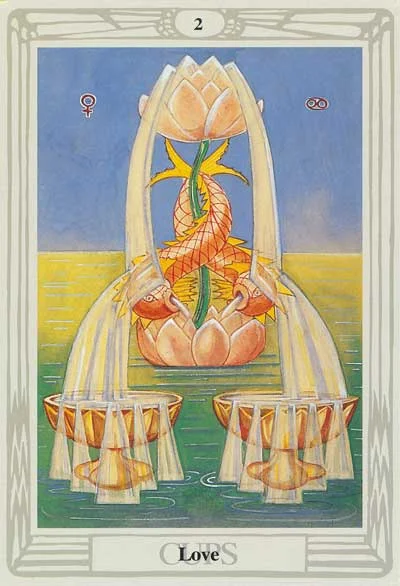
Love is in the air, everywhere I look around

Today Venus is in Pisces which is the sign of the two of cups. Happy lovers rejoice!
-

New Site Feature
The Old Cafe has added a library which you can find in the top menu. The books are a bit niche, but we’ve also opened up registration so you can get a free library card. Support the dissemination of knowledge but be careful. Some of the books inside are meant for initiates only and should not be opened at all beyond your accepted grade.

-
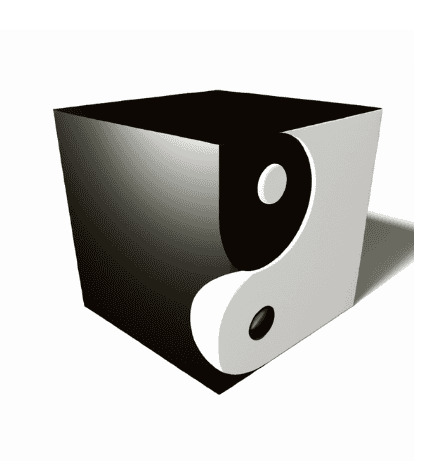
Seeing Into Darkness: Integration of the Shadow
Having taken a deep dive into parts work as described by Teal Swan your editor has stumbled across a deeper connection to shadow and the world it encompasses during a prolonged bout of insomnia accompanied by meditation and prayer. At this point in psycho-spiritual development, it takes about 2 days of no sleep to start integrating higher dimensions into 4-d meatspace, but after a little over a week, a whole new realm right here in 4-d became apparent. I was completely unprepared for what I saw.
Most of us sitting here now, in human bodies, in our human society, are interacting only at the membrane of the light side. All of our forward-facing attention and belief in the “real world” allows us to interact, believing in positivism and the faith that goodness and light are the superior and favored mode of evolution. I’ve got news for you brother(soror), we are operating with willing blindness towards the equality of the dark side. There is an equal and opposite direction right here in 4-d, that’s just as real. Being accustomed to, even in the darkest moments, looking towards what is forward for most of us, the light side of point events, cannot begin to prepare one for seeing into the other half of this reality. Even the most hardcore edgelord Luciferians are going to balk at the level of what seems like horror when first encountered.
I say horror because when first apprehended, it looks like every nightmare fantasy come true. Whereas we are used to, in shared reality, individual point events spinning forward into more observable point events, that tend towards further faith in the basic goodness of things, in the shadow half of 4-dimensional spacetime, these events have their undoing. From the same event in point-space that we desperately cling to for some kind of positive movement or structure, the ripple into darkness manifests every way evil, chaos, murder, destruction, and violation proceed from that very same point event. This is the world that your personal shadow inhabits at all times. This is why it is so difficult to accept the shadow into our waking consciousness of ourselves. It is a mirror world where all our darkest imaginations are playing out, and the people who put the most effort into “being good’ in this world have the most suppression of energy into their shadow, and therefore the most highly developed horrors right at the back of their mind.
All my cherished views of self were challenged by this encounter, and I begin to see all the ways in which I have been wrong, by forcing myself into culturally accepted forms of goodness. What is, is what is, and your friendly neighborhood serial killer is actually producing less horror on the darkside, by expressing it here in the positive world. One of the most incredible discoveries in my first deep foray into shadow, is all this earth friendly, eco-conscious save the Earth stuff is absolute bullshit. The world as she is, has created us to do exactly what she wants us to do, and that includes strip mining and clear-cutting forests as much as planting trees. She delights in the wires we have buried in the ground and her newfound expression in AI fueled networks. Oil pipelines excite her as much as old-growth rainforest, and when we are done pleasing Her, she will be rid of us at once. By all means, if you want to maintain a healthy environment and outlook don’t shit where you eat, but even if you do, it’s still an expression of what the Earth has created.
If you want to continue to learn and know the Gods, brace yourself, it’s not Disney, unless you also include all that pedophilia, abuse, media domination, global exploitation, eugenics and profiteering. That’s two sides of the same coin.
-

I Guess we should move onto the hard problem
The ever-present algorithm liked yesterday’s content and is just bursting with suggestions for today’s musings so here goes. The physical underpinning of reality is just a formalization of relations between more than 10 and less than 100 ratios describing physical forces. They are a statement about what we perceive, but we haven’t operationalized perception, so we have no ground to build upon. I had completely forgotten that this can be referred to as “The Hard Problem” of consciousness, and as I am engaged in consciousness studies, it requires mention. George Musser gives it a shot here, but his survey of currently popular research terms doesn’t exactly turn the search for a foundation on its head. I think we can make a little further progress and stop putting Descartes before the horse, by refuting Cogito Ergo Sum and de-identifying thoughts from the thinker.
The Musser article and scientistic analysis of consciousness, in general, are not doing a very good job of separating the subject and object of consciousness. It’s probably because given the scary proposition that they are nothing the researchers involved have fallen back on the identification of self as one’s thoughts. The idea we are a mind piloting a meat and bone mech and that our minds are separate from the external world. Spend enough time in meditation and you will realize that this is not the case.
Your thoughts are as external as the wall on the far side of the room. The root of your consciousness is witnessing those thoughts and usually half-dozing at the same time. You need to understand the mind is external to the Self and is something being observed, while it is also reacting to the being witnessing it. A thought is an object more gaseous than a ’59 Edsel or a stapler but it’s still an object, it just has the benefit of being closer in space-time to the witness of mind. The field of observable objects is as large as creation and continuous and usually, you only perceive the part closest to you, but it seems to be a little faster and more interesting than the farther-out bits. It has the immediacy of perception, so seems important, but it’s just variation in the object field and that’s where relativity creeps into the definition needed for the hard problem. We need a formalized rational description of subject-object relations in the same way we need an abstracted statement of relationships between forces decoupled from measurement units based on the length of a king’s foot. Perhaps it’s just the speed of thoughts being accelerated around the core of consciousness as a function of distance that makes it seem like we have a personal mind, but the Hard Problem cannot be solved unless we operationalize duality in the subject-object split. -
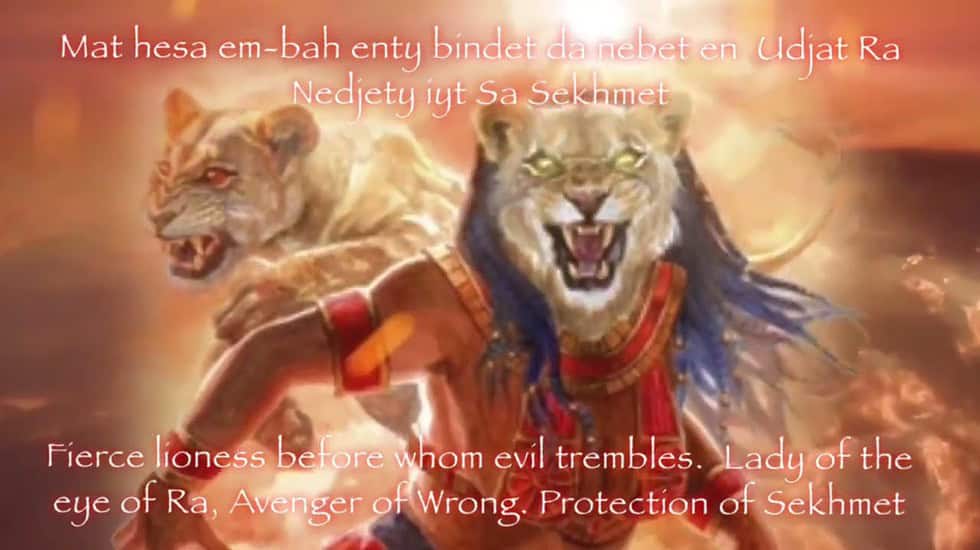
Navigating Self-Healing Through Sonic Resonance: Unveiling the Sekhmet Mantra
Alright, let’s delve into the intricacies of energy healing, those overlapping frameworks of Egyptian Seichim, Reiki, and Yoga, and the curious dance of sound in our quest for self-healing. Now, before you roll your eyes and mutter, “Here we go again,” just hang tight – we’re in for a ride that might make you reconsider dismissing the metaphysical just yet.
So, picture this: I’m wading through the quagmire of life, grappling with energy, chakras, and all that jazz, when I get blindsided by this gnawing illness hanging out right around my throat chakra. Classic, right? The kind of thing that prompts you to wonder if the universe is handing you a cosmic Post-It note that reads, “Speak up, pal!”
My throat’s got a bump, a noticeable bump – one of those things you can’t not think about once you notice it. I’ve tried the whole visualization gig, channeling my inner wizard to shrink that sucker. Results? Yeah, a marginal decrease. But let’s face it, my lymph node isn’t exactly having an epiphany through guided imagery.
So, what’s next? Enter the sonic solution. The age-old practice of using sound as a spiritual crowbar – in this case, a chant dedicated to Sekhmet, the lion-headed goddess of Egypt, a deity with a reputation for the whole healing and transformation bit. Can a mantra actually nudge my rebellious lump into submission? Well, it’s worth a shot, right?
The mantra goes something like this: “Mat hesa em-bah bindet da nebet en Udjat Ra Nedjety iyt Sa Sekhmet.” A mouthful, I know. But hey, complexity is part of the spiritual charm, isn’t it? As I mumble through these syllables – a linguistic code to unlock some kind of ethereal healing vault – I can’t help but feel a bit like a character in an avant-garde play.
So, there I am, reciting these cryptic lines, feeling more than a little absurd. And yet, something curious happens. There’s a resonance, a vibration that resonates within me – like I’ve tapped into some frequency that’s been dormant. The lump, the focal point of this bizarre ritual, starts to show signs of retreat. Now, don’t get me wrong – this isn’t an instantaneous miracle cure. But it’s something.
As I oscillate between skepticism and wonder, I find myself caught in the paradox of self-healing. Is it the incantation itself? Or perhaps the intention behind it? Maybe it’s the sheer novelty that’s kickstarting a shift in my energy. Who knows? And that’s the thing about this journey – the more you look, the less definitive the answers become.
So, here’s the takeaway, friends: this Sekhmet mantra might be an unlikely protagonist in my quest to tame the lymph node beast. Yet, it serves as a reminder of the potency we hold within us to provoke change. Whether through esoteric syllables or placebo-effect psychology, the bottom line is, we’ve got tools beyond the tangible to navigate the complexities of healing.
As we tread through this labyrinth of sound and energy, let’s embrace the uncertainty, the quirky rituals, and the paradoxes that come with it. After all, whether you’re a hardcore skeptic or a devoted spiritualist, there’s one undeniable truth we can all agree on: the journey’s far more interesting than the destination.
-
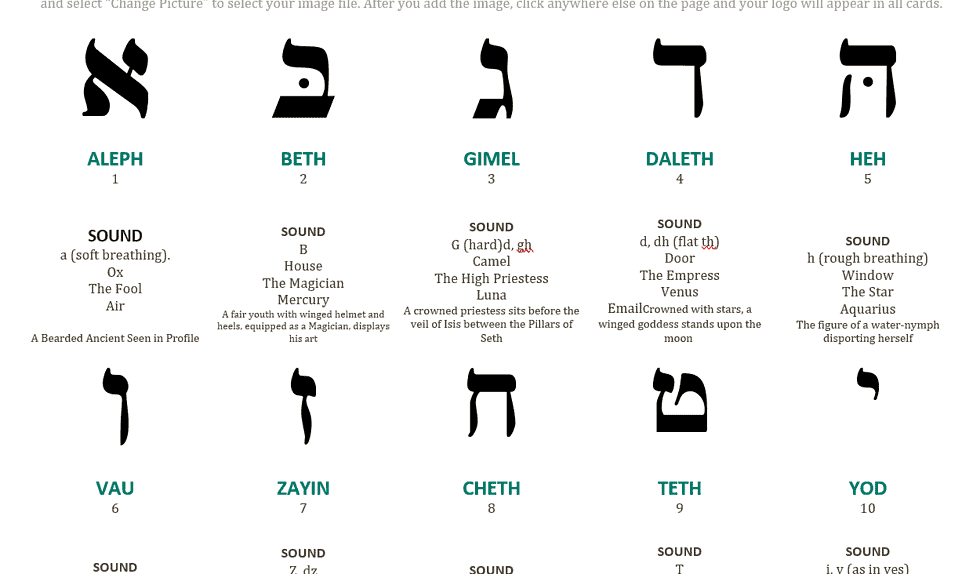
Kabbalah Flash Cards
Have you been struggling to learn the numbers and significance of the Hebrew letters for Kabbalah? Maybe need a little help for pathworking or Gematria? Trying to follow along with Lon Duquette but he lost you on the memorization part? Well, Uncle d’s got something for you. A printable set of Kabbalah flash cards. It’s in docx format, but you can print it onto perforated business card stock and use ’em for memorization. Simple as that. I used Avery business card stock that I had sitting around, but do as thou wilt. (some of the cards are doubled up as 22 doesn’t go into 30 evenly, just deal with it)